
Grocery Retailers: Turn Private Label Into a Competitive Advantage


How can today’s grocery retailers transform private label into a strategic engine for growth and profitability? It starts with a strong Product Lifecycle Management (PLM) practice that connects people, processes and product data.
In a presentation at Groceryshop 2026, Reid Swanson, Centric Software® Vice President, Grocery Retail, highlighted the growing value and urgency of Product Lifecycle Management (PLM) adoption for retail private label programs. In a standing-room-only session, he encouraged attendees to adopt what he called a “private label practice” approach that moves beyond traditional methods of product procurement, outsourcing and recordkeeping to accelerate growth, increase profitability and strengthen shopper loyalty.
The message resonated beyond the Groceryshop stage. Progressive Grocer covered Reid’s session, highlighting his perspective on what retailers need to turn private label into a strategic driver of growth, profitability and shopper loyalty.
The growth of grocery private label is accelerating, its strategic importance is rising and retailer programs are becoming increasingly complex. Recently, 95% of retail executives responding to the FMI Power of Private Brands: Consumer Trends survey said private brands are “extremely” or “very important” to their organizations. Over the next two years, 86% confirmed plans to “moderately” or “significantly” increase their private brand investments.
These expectations come at a time when the industry is moving faster than ever, driven by the convergence of several “macro drivers,” Swanson said:
- Inflation. Over the last five to six years, grocery prices have increased significantly.
- Budgets. Higher prices mean consumers are spending a greater proportion of their income on food than they have in the last 30 years.
- Disposable income. Higher costs mean consumers have less money available for other purchases.
- Price sensitivity. Rising costs have more shoppers considering alternatives.
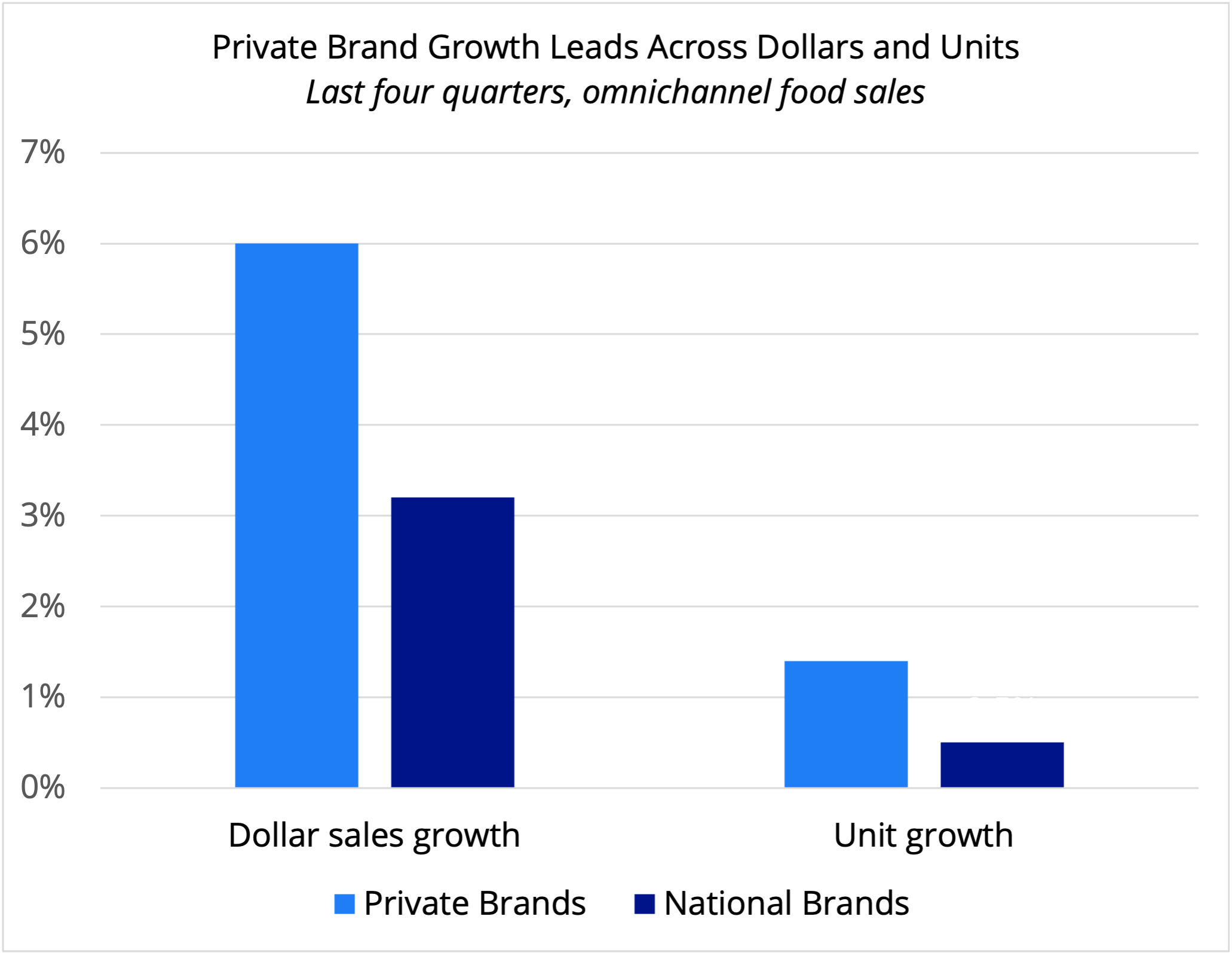
Private label dollar sales growth at 6.0% is currently exceeding that of national brands at 2.3%. Unit growth for private brands is nearly triple that of national brands, at 1.4% versus 0.5%.
Against this backdrop, grocery retailers increasingly recognize the opportunity to expand and strengthen their private label businesses.
“Consumer behavior is not something that is very easily changed,” he observed, adding that amidst all the instability in the marketplace and in the industry, he sees both opportunity and imperative on the horizon for retailers.
Growth, profitability and especially loyalty
Swanson presented a framework for positioning retailers’ private label businesses as strategic profit engines that can deliver on three fronts:
- Ability to capture new category opportunities quickly
- Higher margins and pricing flexibility
- Enhanced differentiation and shopper loyalty
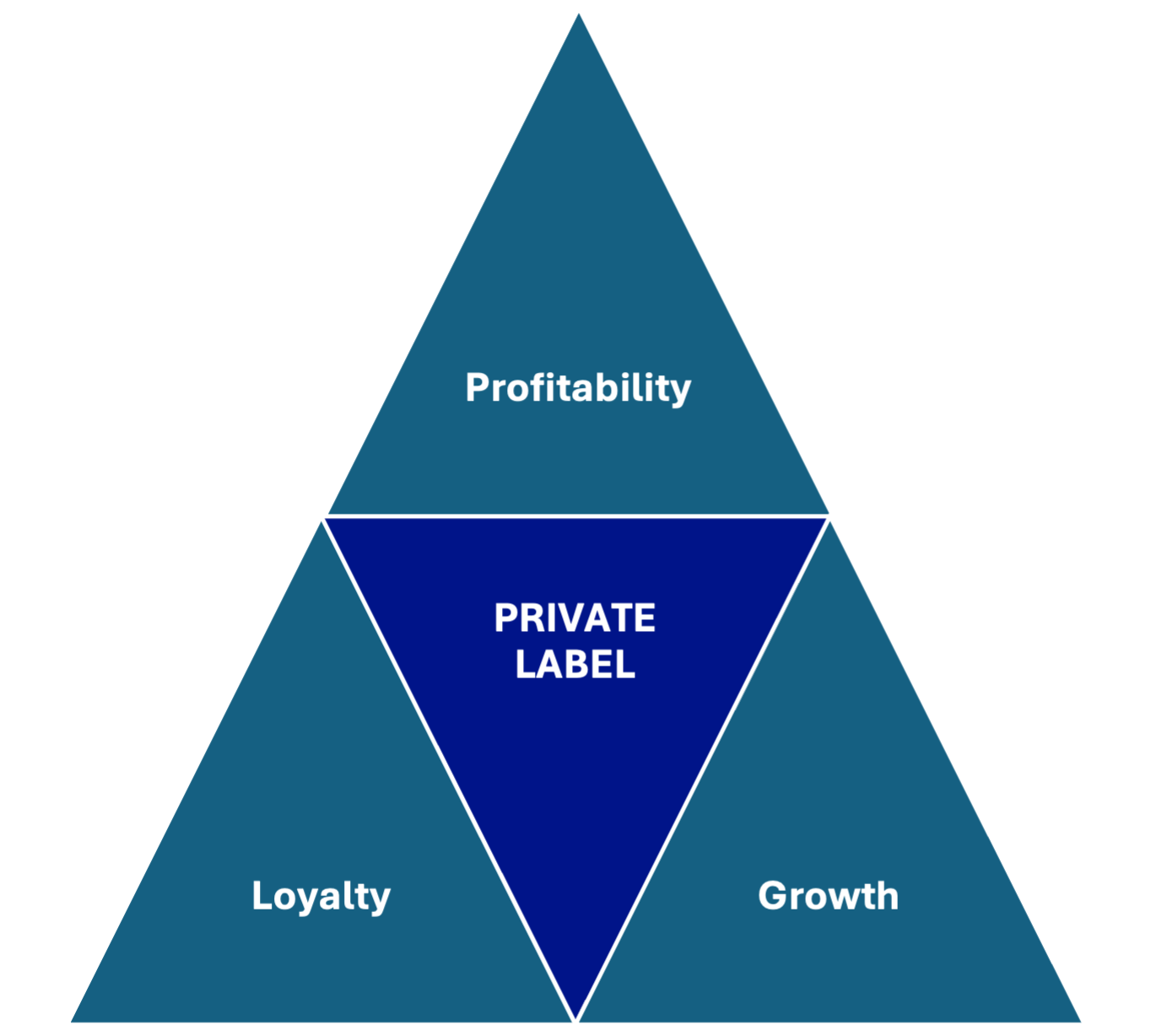
Sales volume and profit growth have long been key objectives for private label. Increasingly, retailers also have an opportunity to use differentiated products and experiences to strengthen shopper loyalty.
“Instead of the consumer just going to their local retailer to find national brands, they are now open to building a new relationship with that grocery retailer and their own brands,” he said.
Readiness to consider alternatives to national brands is particularly pronounced among younger shoppers who are developing trust in retailers and discovering exclusive products that deliver the quality, value and experience they expect.
Said Swanson, “The most successful retailers will be those that have built up a successful private label where the people don’t even realize that it’s necessarily a grocer’s private label. They’ll just know that this is a product that they know and love and they’ll start to become more loyal to that retailer.”
From complexity to control
Centric Software partners with eight of the world’s top 12 retailers and serves more than 20,000 brands globally. This extensive industry experience provides valuable insight into the challenges grocery retailers face as they scale their private label programs.
“One of the biggest challenges that we see is that most grocery retailers are not built to have a successful private label practice,” Swanson said.
Many retailers have established systems for specifications, procurement and other critical functions, but those systems are often siloed and difficult to scale. As retailers add SKUs and bring more product development and decision-making responsibilities in-house, managing complexity becomes increasingly difficult with spreadsheets, email and disconnected systems.
A modern private label practice requires retailers to respond quickly across multiple dimensions. They need to react to consumer trends, manage regulatory compliance and adapt formulations as FDA and other regulations evolve. Raw material sourcing may need to shift quickly in response to tariffs, supply disruptions or weather events. Packaging may also need to change to comply with varying state recyclability and extended producer responsibility (EPR) requirements.
Speed to market adds another layer of urgency. Extended development timelines can cause an on-trend product to miss its window of opportunity entirely.
These challenges multiply as retailers expand their private label businesses and add more SKUs to their assortments, Swanson said. “It’s almost impossible to scale efficiently. The more you build out your private label the more responsibility you’re taking within your organization.”
As private label programs continue to grow, retailers need processes and technology that can scale with them.
Collaboration is core to a private label practice
Leading retailers are recognizing the value of a PLM platform that connects product teams, data and workflows in one place. This creates a foundation for collaboration across internal functions as well as with suppliers, co-manufacturers and other external partners.
Said Swanson, “Once you have that product brief, once you’ve identified that white space, you can start to push your product through the process. Everyone working on the same iteration. Everyone knowing what the last changes were made.”
By connecting teams and product information throughout the lifecycle, grocery retailers can manage complexity while creating more efficient paths from product concept to commercialization.
Final thoughts: Key elements for success
One significant advantage retailers bring to private label is access to extensive shopper and purchasing data. They know which products their customers buy, what performs well and where opportunities may exist. Applying those insights enables retailers to prioritize the categories, products and opportunities that can deliver the greatest value to their business.
When it comes to turning that data advantage into action, however, modernizing PLM does not automatically mean developing a custom solution. Swanson shared several considerations for retailers evaluating their approach:
Buy PLM and build links to AI. There is a growing temptation for retailers to create custom PLM applications using AI “vibe” coding. Many retailers have assembled sophisticated AI teams, but PLM first requires a strong digital foundation. That includes supplier libraries, raw material libraries, compliance regulations, and other critical product information. Once that foundation is established, retailers can explore opportunities to layer custom AI capabilities on top.
Swanson described a project now underway with a large retailer, where Centric Software is enabling their AI teams to access the PLM system via MCP (Model Context Protocol). This approach may represent an emerging model for retailers looking to connect enterprise product data with their AI initiatives.
[MCP (Model Context Protocol) is an open-source standard for connecting AI applications to external systems.]
Leverage collective knowledge. Centric PLM™ incorporates thousands of hours of industry experience, user input, testing and best practices. Retailers can leverage that accumulated expertise rather than starting from scratch, while continuing to adapt processes to their unique business requirements.
Build shopper loyalty through strong product experiences. As private label becomes more strategic, success goes beyond offering a lower-priced alternative. Retailers that consistently deliver products shoppers know, trust and seek out can strengthen differentiation, loyalty and long-term profitability.
Centric PLM powers a strategic private label practice
Centric PLM connects the people, processes and product data required to execute private label at scale across five critical areas:
- Speed to market
- Quality and compliance
- Innovation enablement
- Operational efficiency
- Sourcing and supplier collaboration
With a connected digital foundation, retailers can streamline product development, improve collaboration, manage growing complexity and make faster, more informed decisions across the product lifecycle.
A strategic private label practice gives retailers the speed, visibility and control to differentiate in an increasingly competitive market while creating products that keep shoppers coming back.
Take your private label strategy further
Private label is evolving from a value alternative into a powerful driver of differentiation, loyalty and profitable growth. But scaling successfully requires connected product development, assortment planning and commercialization.
Discover how leading grocery retailers are connecting people, processes and product data to execute winning private label strategies.